close


Fernando Herrera


My Projects

BeWell
A wellness app catered to nurses centered around Barnsdall Art Park

BeWell
A wellness app focused around Barnsdall Art Park that provides mindful exercises, a social hub for the local community, and a badge system that uplifts artwork from the artists at art museum.

Problem
An issue we encountered at Barnsdall Art Park was its occlusion from its neighboring counterparts. It's a very secluded area with little to no visibility outside the city with strict rules making it difficult for visitors to do any sort of activities. So who is this park catering to?
Insights
Within a half-mile radius, three major hospitals are neighboring Barnsdall Art Park, Children Hospital, Hollywood Hospital, and Kaiser Permanente Hospital, with over 13,000 workers. During the research phase, we saw many hospital workers converging to Barnsdall Art Park while on break or getting off their shifts. Desktop research showcased that there has been significant reports on healthcare workers going through burnout, mental health problems due to their jobs, and the stresses of managing their jobs and outside responsibilities.

Solution
Develop a wellness app that utilizes geo-fencing to get our users into Barnsdall Art Park, a natural environment separated from city life. The app includes aspects of a social app, nodes nodes-based activity tracker to build a data portrait of the user's progress, and a badge system that rewards users with artwork from the art museum.
dimo
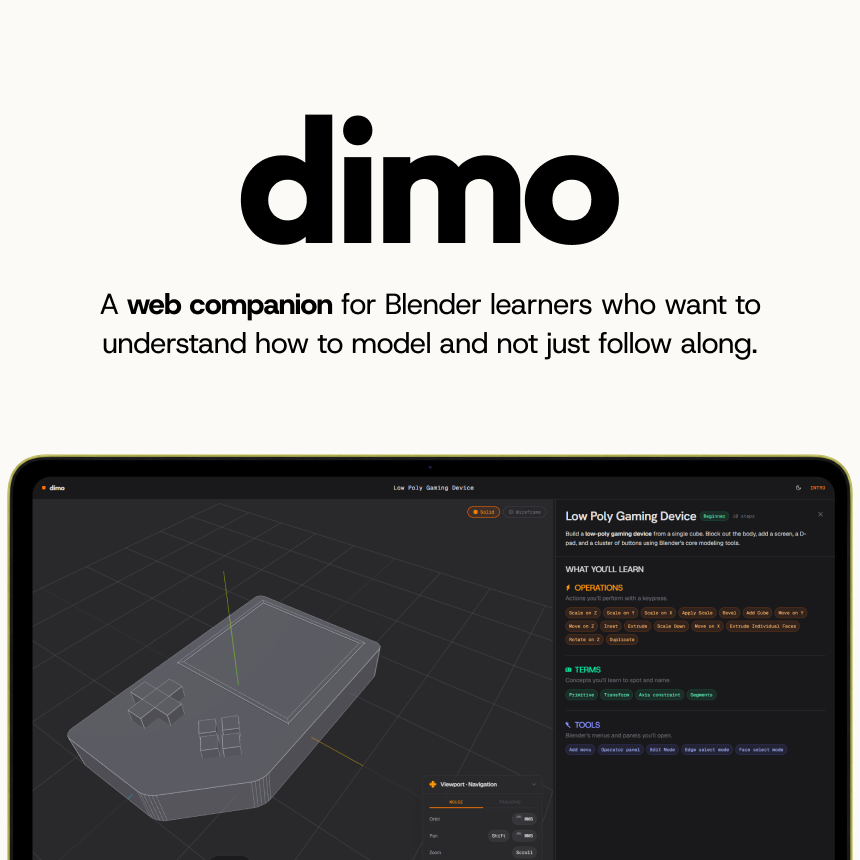
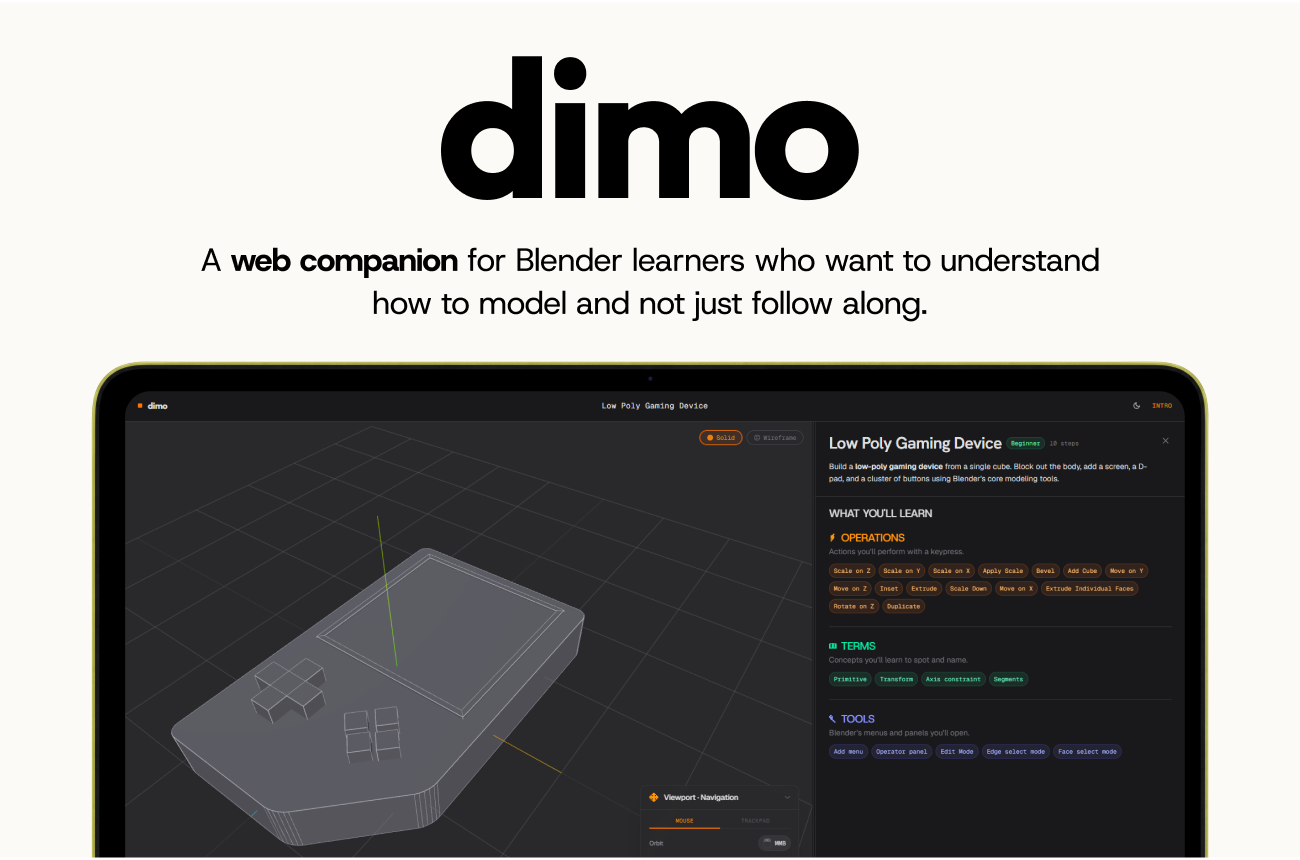
A web companion for Blender learners who want to understand how to model and not just follow along.
dimo
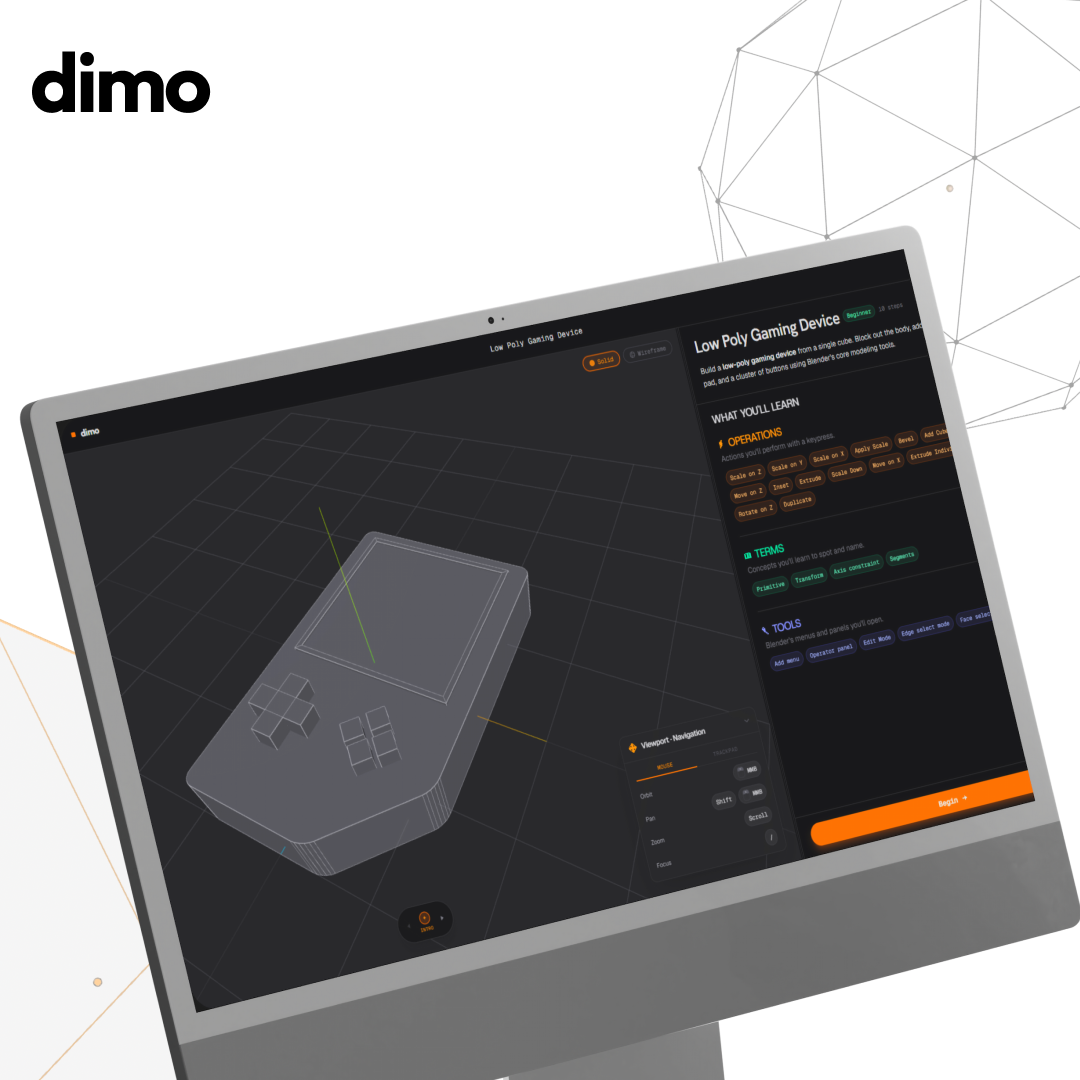
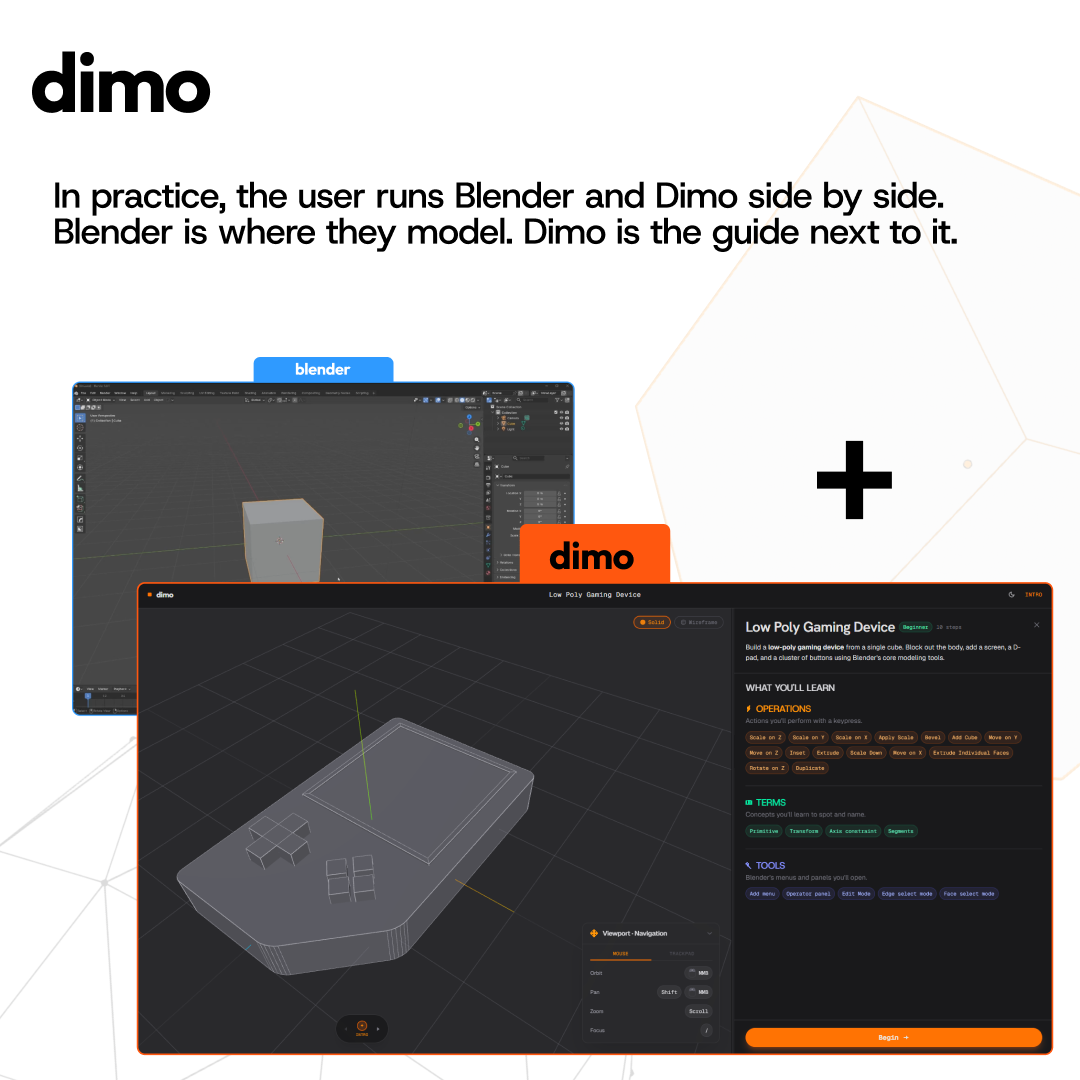
Dimo is a web companion for people learning Blender, an open-source 3D modeling software. Blender has a steep learning curve, and most of its users are self-taught. Dimo is built on the idea that beginners learn more by doing than by following. Rather than watching a tutorial, the learner is asked to problem-solve at each stage, working out how the model is built. The model is broken into stages: a step-by-step sequence from starting shape to finished form. The learner moves through these stages at their own pace, rotating, inspecting the geometry and more. If learners experience friction, they can reveal hints to learn modeling techniques to encourage new processes in their workflow. Dimo rests on three principles: the learner sets the pace, the challenge is consistency, and doing is the learning process.
Problem
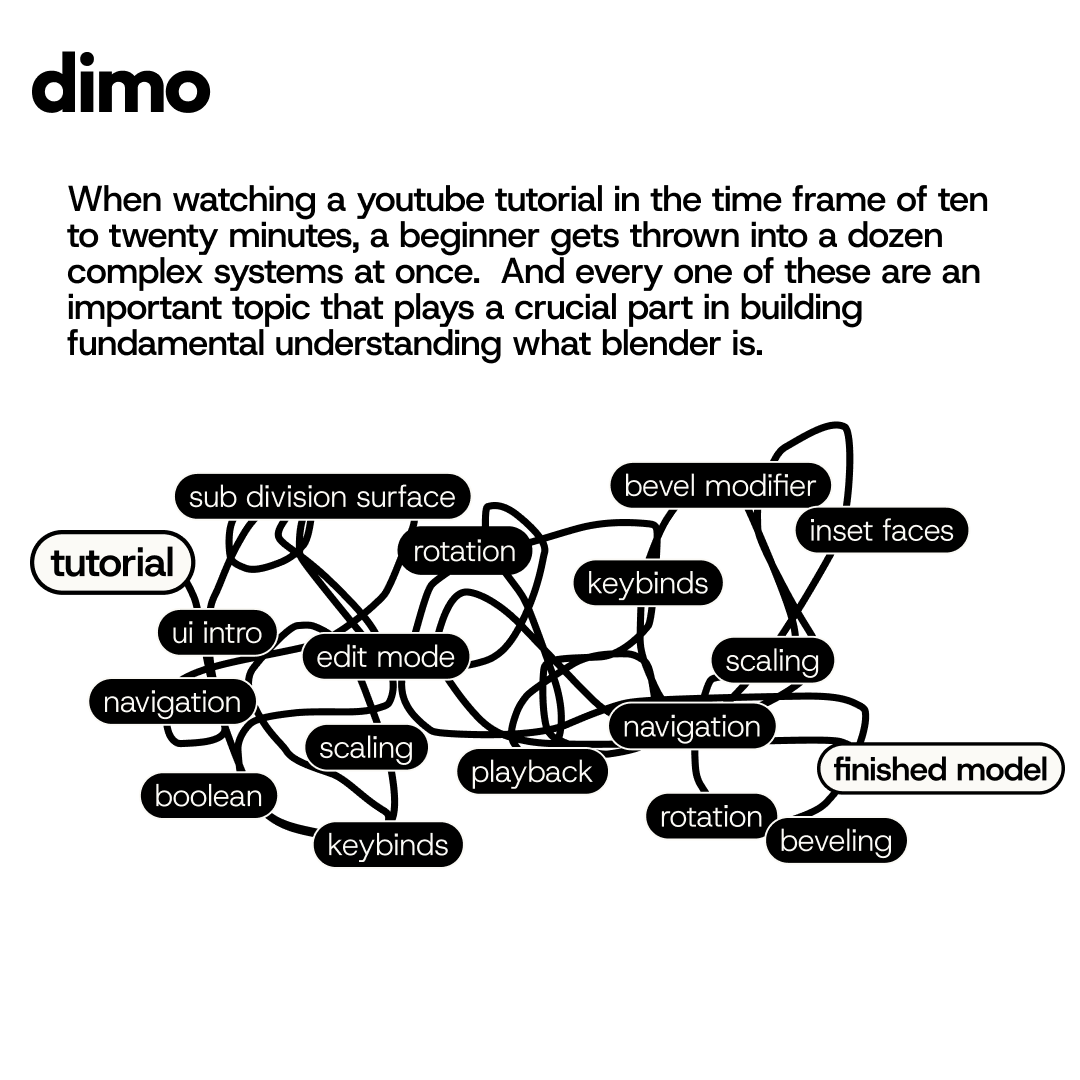
About eighty-five percent of people who download Blender quit in their first few attempts. That amounts to about 1.7 million users who have opened Blender who have never returned.
Insights
Secondary research: Dug into 30 years of research on how people learn software to understand why video tutorials leave learners stuck. The number that stuck with me: across 6.9 million viewing sessions, people tune out of instructional videos after about six minutes no matter how long they are, and most Blender tutorials run 10 to 40 minutes. Other studies showed the same pattern, people can follow a video in the moment but can't redo the work a week later, and the hardest part isn't any single video, it's finding the right next one and applying it to your own project. Community research: Read through a popular Blender thread where people vent about being stuck in "tutorial hell," and looked at how Kaggle teaches by doing instead of watching. Hearing real learners describe the exact frustration the studies predicted made the problem feel real, not just academic. User Testing: Put Dimo in front of a first-time user and watched them learn the basics, entering Edit Mode and making their first bevel. The moment that mattered: after one guided run-through, they rebuilt the model on their own with no tutorial and no notes.
Solution
Dimo is a web app that teaches Blender by letting people learn the way they actually retain things: by doing, inspecting, and going at their own pace instead of watching a video they can't keep up with. Dimo's tutorials are presented in stages of a 3D model progression from a simple shape to it's final form. The learner can orbit, zoom, and rotate each stage, jump backward and forward freely, and stop on any moment to study how the shape was actually made. The clean geometry stays visible the whole time, which is exactly what someone needs to understand modeling but can never pause a video long enough to see. Every step pairs the action with its keyboard shortcut and explains the vocabulary right where it happens, so terms are learned in context rather than memorized from a glossary. Each lesson ends with a real test of understanding: the learner rebuilds a model on their own, with no guidance but a cheat sheet of everything they learned.
