close


Marcus Thomas


My Projects
_thumbnail_image%20-%20Marcus%20Thomas.png)
Casey
A hybrid digital-physical neighborhood companion.

Casey
Casey is a hybrid digital-physical experience where you can access a mobility assistant that uses advanced robotics and intuitive design to provide seamless, on-demand support.
_hero_image%20-%20Marcus%20Thomas.png)
Problem
Although Mid-City, Santa Monica residents live in a walkability oasis, we learned that the majority of them preferred using a car to get around. This lead us to the problem statement - "How might we make the "first/last mile" experience more engaging and spontaneous for Mid-City, Santa Monica locals, so that they can drive less and walk more?"
Insights
Through our research, the team discovered some very interesting statistics regarding the way people approach transportation and mobility in the area. Of particular note is the fact that Mid-City, Santa Monica has a Walkability Score of 92. This score is used by civic planners, real estate companies, and even universities, in order to find out whether a city can be considered a 15-minute city. Amenities are aplenty and well within a short walking distance, and yet, according to surveys submitted by residents, only 10% of residents walk or bike as their preferred method of transportation. While looking at this small number, we started asking who are these people in the first place. Pretty much immediately, we thought of - the elderly and people with physical disabilities. When looking at the most recent US Census for the area, we found out that 18.8% of Mid-City, Santa Monica residents are over the age of 65. With these insights in mind, we had our sights set on developing a concept that can accommodate and is, more importantly, user friendly for the fringes of our the local population. This ethos was reinforced on a trip to BMW Designworks, where they stated on their own most recent mobility project that, "If it works for the fringes, then it will work for everyone." Another thing that struck us was that, if we were to create a project that would help residents with mobility and transportation (and in result, get them walking more), we needed some sort of physical component to this project to help them navigate the city. To better understand this, we looked at precedence regarding Micro Mobility and Automated Utility. Santa Monica as a whole is no stranger to newly introduced tech, so we wondered how communities used and perceived, these two technologies in the area. There were some extreme examples of poor community reception (ie. Lime e-scooters' abrupt rollout in 2018), positive community reception (ie. Veo e-bikes and e-scooters, and their slower rollout), and plenty of grey (ie. Waymo and their years long regulation and tech battle to finally get approved for testing, as well as their strong positive publicity push) to gather info on how to win over the community. We also looked at other use cases for these technologies in geo-fenced areas, like delivery robots on college campuses and airport luggage robots to better focus our efforts on not trying to create an "everything" robot, but something with a stated goal that was relevant to our users. Bearing this in mind, the team didn't just want the solution to help people understand where they are going, but offer them a helping hand to their destination.
_detail_image_1%20-%20Marcus%20Thomas.png)
_detail_image_2%20-%20Marcus%20Thomas.png)
_detail_image_3%20-%20Marcus%20Thomas.png)
Solution
Casey addresses the challenge of encouraging Mid-City, Santa Monica residents to walk more in a way that feels natural, supportive, and engaging. Rooted in the insight that walkability isn’t just about infrastructure but also accessibility and agency, Casey combines a digital app with a physical mobility assistant to make the “first/last mile” experience seamless. This solution focuses on the real needs of the community, starting with those often overlooked in design: older adults and people with physical disabilities. By doing so, we were able to create our guiding principles of Usability, Delight, and Freedom of Movement. These principles led us to designing a product that is intuitive and accessible for everyone, sparks joy through small moments of interaction, and empowers users to navigate their city on their own terms.
Feeling the Fastlane
A haptics-centered VR experience that focuses on F1 pit-crew
Feeling the Fastlane
"Feeling the Fastlane is a haptics-centered VR education experience that uses the world of Formula 1 pit crews as a case study for embodied learning. The project asks how immersive technology can help people rehearse coordinated, procedural work before entering high-risk or hard-to-access environments. Inside the experience, learners step into an F1-style pit lane and move through a guided sequence of short educational videos and interactive tasks. They operate a tire gun, adjust a front wing, and reset electronics while receiving visual, audio, and tactile feedback through haptic gloves. Each task represents a transferable learning pattern: control, calibration, and verification. Although motorsport provides the setting, the larger goal is to explore the future of XR education. The project points toward training systems for fields like surgery, emergency response, industrial maintenance, and energy infrastructure, where repetition, timing, and confidence matter. By combining story, simulation, and physical feedback, Feeling the Fastlane reframes VR as more than spectacle: a tool for practicing complex skills through the body."
Problem
"The problem I focused on was how people learn complex physical procedures before they have access to real-world practice. Many technical skills cannot be fully understood by watching a video, reading instructions, or observing an expert. They depend on timing, sequence, pressure, feedback, and physical confidence. This is especially true in environments like surgery, emergency response, industrial maintenance, and technical field work, where mistakes can be costly and realistic practice can be difficult to access. Feeling the Fastlane uses Formula 1 pit-crew work as a case study for this challenge. A pit stop is fast, coordinated, role-based, and highly physical, making it a strong example of procedural work that depends on the body. The challenge was to design a VR experience that felt exciting without becoming just a racing game. I had to balance spectacle with learning, realism with approachability, and haptic feedback with clarity. What I overcame was the complexity of turning a high-pressure team activity into a focused solo prototype. I simplified the experience into three transferable learning patterns: control, calibration, and verification. By combining short 360 videos, guided interactions, and tactile feedback, the project explores how VR can make procedural learning more repeatable, memorable, and embodied."
Insights
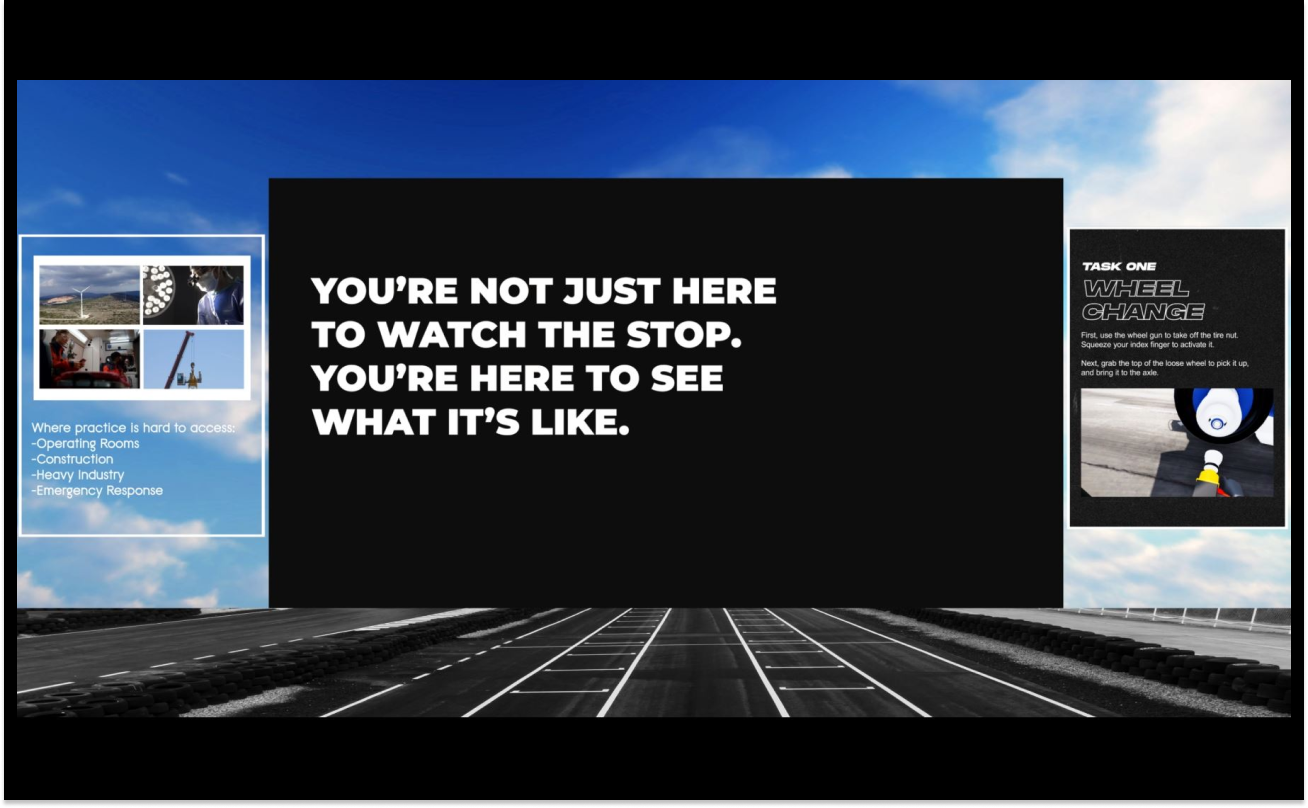
"My process began with secondary research into XR education, haptics, simulation training, and industries where realistic practice is difficult to access. I studied examples like surgery, emergency response, industrial maintenance, and energy infrastructure to understand where VR could provide value beyond entertainment. From there, I used Formula 1 pit crews as a focused case study because pit stops make coordinated work visible through roles, timing, sequence, pressure, and feedback. A key insight was that the project could not simply be about recreating a pit stop. It needed to translate pit-crew work into transferable learning patterns. Through research, storyboarding, and feedback from mentors and subject matter experts, I narrowed the experience into three core skills: control, calibration, and verification. These became the foundation for the user journey and interaction flow. I also developed low- and mid-fidelity prototypes to explore how 360 videos, guided VR interactions, and haptic feedback could work together. User testing and iteration helped me realize that clarity mattered more than realism, and that haptics were strongest when used as confirmation instead of constant stimulation. The biggest insight was that VR learning works best when story gives the task meaning, interaction gives the learner agency, and feedback helps the body understand what correctness feels like."
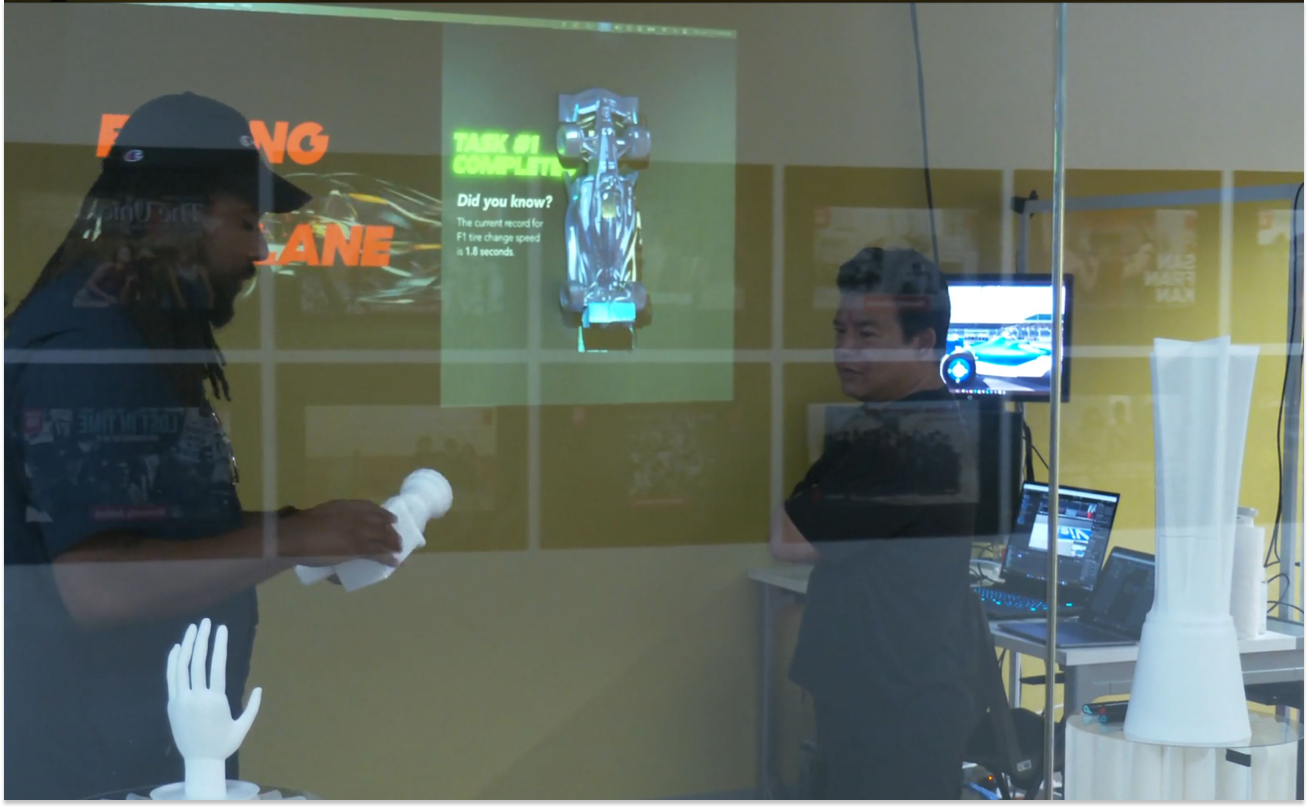
Solution
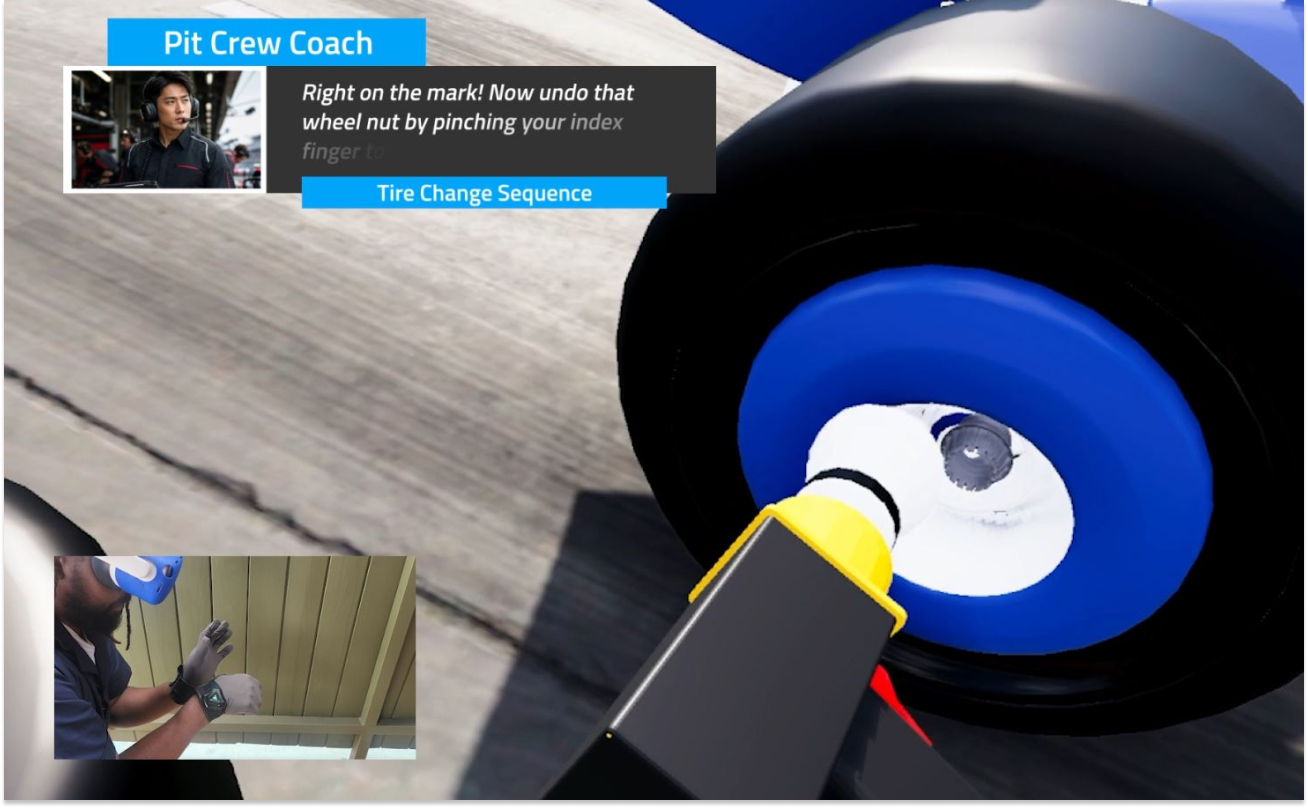
"The final solution is a short haptics-centered VR training prototype that turns Formula 1 pit-crew work into an embodied learning experience. Rather than asking users to simply watch a pit stop, Feeling the Fastlane places them inside a guided sequence where they learn by performing. The experience combines 360 educational videos, interactive VR tasks, and haptic feedback to teach three transferable skills: control, calibration, and verification. The prototype is structured as a learning flow. First, the user is introduced to the larger idea of embodied training. Then they complete a tire gun task focused on tool control and tactile confirmation. Next, they adjust a front wing to understand calibration and how small changes affect a larger system. Finally, they reset electronics to practice verification through sequence, status checks, and confirmation. A key feature of the solution is the way each task connects to a broader learning pattern beyond racing. The project uses F1 as the setting, but the final design points toward applications in surgery, emergency response, industrial maintenance, and energy infrastructure. By combining story, guided action, and physical feedback, the prototype shows how VR can make procedural learning more repeatable, memorable, and accessible."
